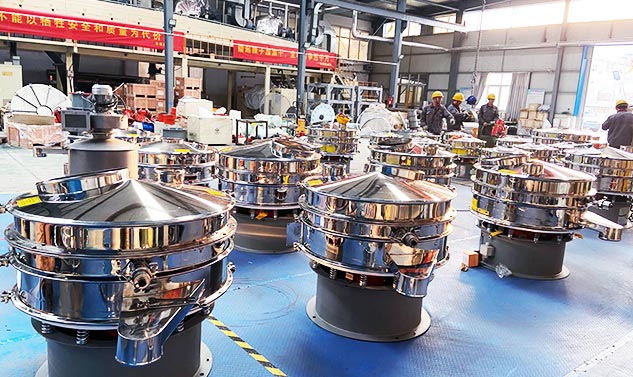
Mesh blinding is a physical effect, not a mesh defect. Whether you need an ultrasonic vibrating screen depends on which force holds your powder in the apertures.
By DZSCREEN · October 15, 2026 · 5-minute read
TL;DR
- Blinding comes from adhesion, agglomeration and particle wedging, not the quality of the mesh.
- A standard rotary vibrating screen covers 3 to 500 mesh; an ultrasonic vibrating screen extends the range to 40 to 600 mesh.
- Ultrasonic vibration acts on the powder and the mesh surface without changing the aperture size or harming the screen.
- On coarse mesh with a free-flowing product, the standard machine is the better buy and simpler to maintain.
A fine powder that stops passing at high mesh is usually blamed on the mesh, which is rarely the cause. Choosing between a rotary and an ultrasonic vibrating screen means deciding which force on the powder has to be overcome.
How Fine Can a Standard Rotary Vibrating Screen Go?
The S49-B range screens from 3 to 500 mesh on frames from Φ430 mm to Φ1950 mm, one to four decks and effective screen areas from 0.11 m² to 2.85 m². Power runs from 0.18 kW to 2.5 kW across the eight sizes.
Within that range the practical limit is the material. A free-flowing powder can run at the fine end for a full shift; a cohesive powder may blind within minutes at the same aperture, and no change of frame size fixes it, because more area does not change what happens inside each aperture.
Why Fine Powders Blind in the First Place
A 2023 review of powder cohesion in pharmaceutical processing lists the contributing factors as liquid bridges, van der Waals forces, electrostatic forces, frictional charging during handling, and particle shape and size, and notes that moisture from the air increases cohesion and reduces flowability (Jones-Salkey et al., 2023). That review covers powder flow in tablet production rather than screening, but the same forces act on a screen deck.
On a screen deck they appear as three mechanisms:
- Adhesion. Fine particles stick to the wire through van der Waals and electrostatic attraction, closing the aperture from its edges inward.
- Agglomeration. Particles bond into clusters larger than the individual particle, and the cluster bridges the opening instead of passing through.
- Wedging. Particles close to the aperture size lodge in the opening. A 2025 study classifies particles between 0.7 and 1.0 times the aperture as the refractory fraction, the group that inhibits screening, which is why the near-size cut blocks first (Shen et al., 2025).
More excitation force does not resolve any of the three; it reduces contact time exactly when contact is what the powder needs.
What an Ultrasonic Vibrating Screen Changes
An ultrasonic vibrating screen is a rotary vibrating screen with an ultrasonic system added to the mesh. A transducer on the screen frame puts the wire into high-frequency vibration; the resulting mechanical wave gives ultrafine powder a large ultrasonic acceleration that suppresses adhesion, friction and wedging, while the transducer's radiating surface contacts the blocked mesh to produce the relative displacement that clears it.
Two properties matter when comparing quotations. The technique does not change the aperture size, so the cut point is unaffected, and it does not harm the screen surface. The ultrasonic power supply, not the transducer alone, is what determines how fine the machine can screen reliably.
The mechanism is supported by a study of ultrasonic-assisted screening, which built an energy balance model including viscous force and ultrasonic vibration energy alongside a force balance model for aggregate break-up and verified experimentally that ultrasonic vibration scatters particles and improves screening efficiency (Chen & Yao, 2022). It is a conference paper on one setup, so treat it as mechanism support, not a promise for your powder.
When a Standard Rotary Vibrating Screen Is the Better Buy
An ultrasonic unit is not automatically the right answer, and the standard range screens as coarse as 3 mesh, against 40 mesh for the ultrasonic range.
Choose the standard machine when the aperture is coarse, the product flows freely and static charge is low: no ultrasonic power supply to maintain, fewer components to fail, and simpler cleaning.
If the constraint is volume rather than fineness, a tumbler sieve is the better comparison: the catalogue lists its screen areas from 0.44 m² to 5.30 m², beyond the round screener range.
Comparing the Two Ranges
The two ranges overlap between 40 and 500 mesh, and that overlap is where the decision is genuinely difficult: the deciding evidence is a trial on your own material, not a specification table.
FAQ
Do I need an ultrasonic vibrating screen?
Where the powder blinds the mesh and the cause is adhesion, agglomeration or static charge rather than the aperture, you need one. If the powder flows freely and the cut is coarse, the standard machine does the same job for less maintenance.
What causes mesh blinding in a vibrating screen?
Blinding is caused by particles adhering to the wire, clusters bridging the opening, and near-size particles wedging in the aperture. Moisture and static charge make all three worse. Blinding is material and aperture, not a mesh defect.
What mesh can an ultrasonic vibrating screen screen?
The S49U-B range covers 40 to 600 mesh across five models from Φ654 mm to Φ1400 mm. Where a standard unit reaches the aperture but blinds in service, the ultrasonic system holds the cut steady; a larger frame does not.
What This Means for Your Line
Decide in this order: confirm the aperture, test material behaviour at that aperture, then size the machine for the output. Only the material test shows whether blinding is a real constraint on your powder or an assumption from a previous line.
If the answer is a standard machine, [INTERNAL LINK: /news/how-to-size-a-rotary-vibrating-screen | anchor: "screen diameter and deck count are matched to output"] covers the sizing inputs.
If fine mesh blinding is the constraint, [INTERNAL LINK: /products/ultrasonic-vibrating-screen | anchor: "ultrasonic vibrating screens for high-mesh powders"] lists the models and mesh range, and [INTERNAL LINK: /products/rotary-vibrating-screen | anchor: "the standard rotary vibrating screen range and its mesh limits"] shows the apertures the standard range reaches without it.
 24 Hours Online Service For You: +86 13462227588