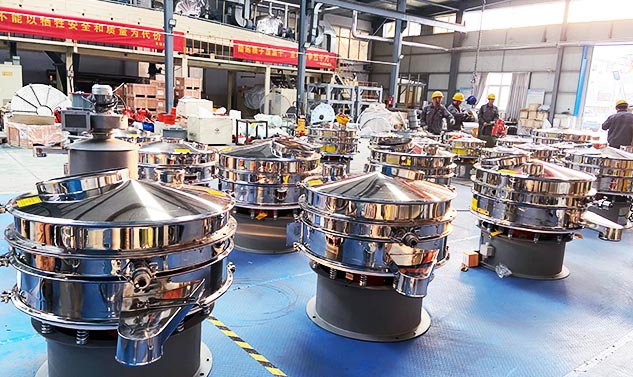
Both machines are round, both vibrate, and both have a mesh. What separates them is where the material goes after it lands.
By CHENWEI · October 22, 2026 · 5-minute read
TL;DR
- Mesh range is the clearest divider: CWPS is published at 5 to 100 mesh, the S49-B rotary series at 3 to 500.
- The direct discharge design gives one pass and one cut; a rotary screen carries one to four decks and can split a feed into fractions.
- Discharge geometry changes the installation: straight down needs headroom, a tangential outlet needs side clearance.
- Lower nameplate power on the direct discharge model is not an efficiency claim; it reflects a single deck with no multi-deck load.
Two round screens can look interchangeable in a photograph and behave nothing alike on a line. The choice between a direct discharge vibrating screen vs rotary vibrating screen comes down to three published figures — mesh range, deck count and discharge geometry — plus what your material actually does at the cut.
Where the product has to go decides half of it: a straight drop into a packing line points to one design, a feed that must leave as two or three grades to the other.
The Mesh Range Divides Them Before Anything Else
The rotary range reaches cuts the direct discharge range cannot, and that removes most of the overlap. CWPS is published at 5 to 100 mesh on every model. Under ASTM E11, No. 100 is a nominal aperture of 150 µm, which is the family's finest cut. The S49-B rotary series is published at 3 to 500 mesh, and a 500-mesh opening is measured in tens of micrometres.
That is about residence time, not quality. A fine cut needs repeated chances at an aperture, and repeated chances need a long path; a direct discharge screen has none.
Where a cell says not published, the data sheet is silent. Ask for it in writing rather than inferring from the other column.
One Motor Underneath or Two on the Sides
The rotary machine hangs one vertical motor under the frame, with an eccentric weight at each end of the shaft. The direct discharge body carries a motor on each side, each with an upper and lower weight. Both move the deck in three dimensions; what differs is how the motion is generated and trimmed.
Two motors give a symmetric drive and two places to adjust the trajectory, which suits a machine keeping a bed moving over a single deck. One vertical motor gives a simpler bearing arrangement, and a taller frame leaves room for several decks on the same shaft. If trajectory settings matter to your material, how the two side-mounted motors produce motion explains the phase angle and weight adjustments.
One comparison cannot be made from catalogues: amplitude and speed are published for CWPS, not for S49-B, so acceleration needs measured data from both. Ask for it if the material is fragile.
Discharge Geometry Decides the Chute, Not Just the Machine
A straight-through outlet is an advantage in a gravity layout and a constraint everywhere else. The direct discharge unit needs vertical room above the deck and clear space below; that is all. The rotary unit sends product to a rim outlet, so the spout leaves sideways and needs clearance plus height to reach the next stage.
This decides which machine fits the building. Fitting a rotary screen into a tight vertical gap between hopper and filler often means raising the hopper; a direct discharge unit may drop into the gap.
When Lower Power Is Not an Efficiency Claim
At the same 1768 mm nominal size, the direct discharge model lists 1.5 kW in total and the rotary model lists 2.5 kW. That reads as efficiency; it is not evidence. The rotary machine can carry up to four decks, and its published area at that size is 2.4 m²; more decks mean more mass to move and more material held on the deck. The CWPS figure covers one deck, with no published area at all.
What the number does tell you is that the duty is lighter: a single-pass scalper working a shallow bed needs less excitation than a multi-deck grader. Judge the machines on the cut and the fractions, then treat power as a running-cost input rather than a score.
When Neither Machine Is the Right Answer
Two other families cover what these two miss: a tumbler sieve for large, fragile or oddly shaped feed up to 100 mm, and an ultrasonic screen where a cut below 150 µm blinds in a fine powder.
Between these two, the rule is short: one cut, coarse, high rate, vertical layout — direct discharge. Several fractions or a fine cut, with room for a spout — rotary.
FAQ
Is a direct discharge screen the same as a rotary screen?
No. Both are round and both vibrate, but the direct discharge design puts inlet and outlet on one vertical axis and passes material through a single deck; the rotary design carries material outward to a rim outlet over one to four decks.
Which one should I use for check screening?
For removing oversize before packing at a high feed rate, a direct discharge unit suits the duty and the layout. If the check sits below 150 µm, only the rotary series reaches it.
Can a direct discharge screen replace a rotary screen?
Only where the cut is 150 µm or coarser and one fraction is enough. Where the rotary machine runs several decks or a fine mesh, a single-pass design changes the product, not just the machine.
What This Means for Your Specification
Write the duty down before comparing quotations: cut in microns, number of fractions, feed rate, and the height available between hopper and next stage. Those four lines eliminate one design in most projects and make the rest comparable.
Both are published in the same nominal diameters, which makes diameter the wrong first question. The sizing inputs sit in how screen diameter and deck count are matched to output, and the CWPS direct discharge vibrating screen range gives the six sizes to check a quotation against.
About CHENWEI
Xinxiang Chenwei Machinery Co., Ltd. (CHENWEI Machinery) is a food processing and packaging machinery manufacturer based in Xinxiang, Henan, China. Its screening range covers rotary vibrating screens, ultrasonic vibrating screens, direct discharge screens and tumbler sieves for powders and granules in food, pharmaceutical and chemical production. Cutting, welding, polishing, assembly and performance testing are handled in-house, non-standard configurations are available, and machines are exported to Southeast Asia, the Middle East, Africa and South America.
 24 Hours Online Service For You: +86 13462227588