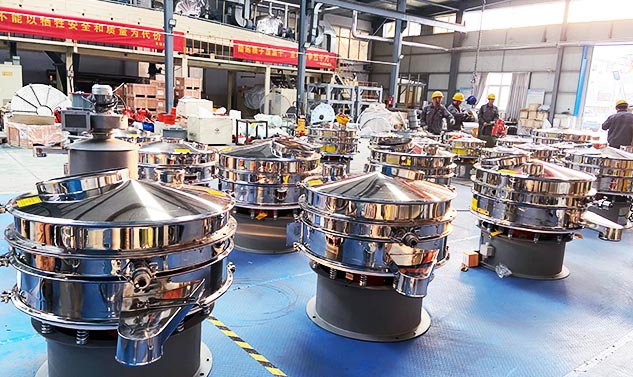
Both are round, both vibrate, and both are sold by diameter. The difference that matters is what happens to the bed when water is present — and one sheet commits to a mesh range while the other does not.
By DZSCREEN · November 19, 2026 · 5-minute read
TL;DR
- A high frequency screen uses a short, frequent stroke; a rotary screen uses a longer stroke to convey material across one to four decks.
- The published rotary range commits to 3–500 mesh and one to four decks; the CWHF sheet publishes neither, so cut size cannot be compared from the two sheets.
- Wet, high-moisture and slurry feeds favour the short stroke, because a loaded wet bed transmits vibration poorly.
- Dry, free-flowing material at high tonnage favours the rotary screen, where area and deck count do the work.
Buyers usually reach this comparison by looking at two round machines of similar diameter and assuming the decision is about size. It is not. Both ranges overlap in diameter, and at roughly one square metre of mesh the two machines draw comparable power. What separates them is the shape of the motion and what that motion does to a bed that is wet rather than dry.
The Two Motions, Side by Side
One moves material across a deck; the other keeps it in place and hits it more often. A rotary screen's longer stroke lifts and carries material outward, which is how one deck can deliver a cut and how three or four decks can deliver several fractions. A high frequency screen shortens the stroke and raises the number of cycles, so the bed stays thin and the particle meets the aperture repeatedly instead of being swept past it.
Four cells say not published, and two of those matter more than the rest. Without a published mesh range, the high frequency family cannot be compared with the rotary family on cut size at all; without a published frequency, "high frequency" stays a description rather than a specification. Ask both in writing before a quotation is compared.
The frequency and amplitude of the rotary range are also unpublished, which means acceleration at the deck cannot be compared between the two machines from catalogues. If the material is fragile, that is the number to request from both suppliers.
What Water Does to the Choice
A dry bed stratifies. Small particles fall through the gaps between large ones, reach the mesh, and pass. A wet bed does not behave that way: liquid fills the voids, surface tension holds particles in clusters, and the mixture transmits vibration less effectively than dry solids.
That is why a long stroke on a wet feed can move a slab of material rather than individual particles. The stroke lifts the mass, the mass lands as a mass, and the water between the particles absorbs part of the energy. A short, frequent stroke works in smaller increments and keeps breaking the structure rather than moving it.
The trade is throughput. A thin, frequently agitated bed passes less tonnage per square metre than a deep bed on a long stroke, so the high frequency machine wins on behaviour where the rotary machine would blind, and loses on tonnage where the rotary machine can run.
Where Each One Stops
High frequency: dry, coarse, free-flowing material at high tonnage, and duties needing several fractions from one pass. The published range offers one mesh specification per model, so a second grade needs a second stage.
Rotary: slurries with a high fines content and heavy loading, where a short stroke cannot move the volume, and fine cuts in a dry powder that blinds — there the answer is ultrasonic assistance, not more cycles.
Neither machine is the right answer for a feed that is mostly water with a small solids load; that is a dewatering duty with different geometry, and a screen sized by tonnage will be the wrong shape for it.
FAQ
Is a high frequency screen better than a rotary screen?
It is better on wet, sticky and high-moisture feeds, where a short frequent stroke keeps the bed working. A rotary screen is better on dry feed at high tonnage and where several fractions are needed.
Can a rotary screen handle slurry?
It can be fed wet material, but its longer stroke is designed to convey solids to an outlet, and a loaded wet bed responds poorly to that motion. Containment is also harder, since the outlet sits at the rim.
Why does one sheet publish a mesh range and the other not?
Because the two families are documented differently. The rotary sheet lists 3–500 mesh; the CWHF sheet lists diameters and motor ratings only. Request the mesh range for the exact model before comparing cut sizes.
What This Means for the Specification
Write the feed first: moisture content, solids loading, the share of particles between 0.7 and 1.0 times the intended aperture, and the tonnage required. Moisture above roughly a few percent changes the answer more than diameter does, and the near-size share sets the efficiency you can expect either way.
Then compare quotations on the variables each sheet leaves out. If the choice lands on the high frequency side, how a high frequency screen trades amplitude for cycles explains the mechanism, and how to specify a high frequency vibrating screen turns it into a purchase specification. The published diameters and motor ratings are listed under the CWHF high frequency vibrating screen range.
About DZSCREEN
DZSCREEN supplies ultrasonic vibrating screens and the standard rotary vibrating screen range compared in this article, for powders and granules in food, pharmaceutical and chemical production. Machine configuration, mesh specification and test screening are matched to the material being processed, and non-standard configurations are available.
 24 Hours Online Service For You: +86 13462227588