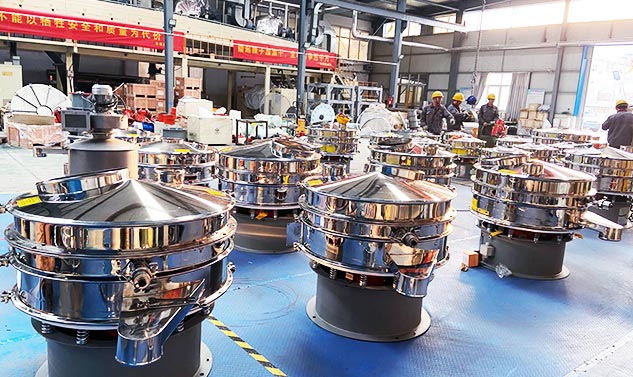
In the pharmaceutical, metallurgical, and specialty chemical sectors, particle size distribution is not a suggestion—it is a strict compliance requirement. Inconsistent classification leads to rejected batches, off-spec final products, and wasted raw materials.
Achieving high screening accuracy requires equipment that can actively separate agglomerated particles and stratify materials rapidly before they exit the discharge port.
High-frequency vibrating screens solve this by applying intense, localized force to the material bed. As outlined in the product introduction within image_8b8920.jpg, the core working principle is separating materials into particles of different sizes through the vibrating screen surface, yielding "high efficiency, high precision, and low noise."
Why High Frequency Equals High Accuracy
Standard screens use lower frequencies and higher amplitudes, which can cause finer particles to bounce over the mesh rather than passing through it. High-frequency machines keep the material closer to the mesh surface. This increases the statistical probability of a particle finding an aperture, drastically improving classification accuracy.
This design is widely applied across multiple demanding industries, including:
Pharmaceuticals: Ensuring uniform API particle sizes for consistent dissolution rates.
Metallurgy and Mining: Classifying fine ores and metal powders for downstream processing.
Building Materials: Grading fine aggregates and specialized cements.
Sizing for Precision
When specifying a unit, the exciting force must align with the material's bulk density and flow characteristics. The CWHF series (image_8b8920.jpg) provides a clear progression for scaling your operation:
CWHF-600: 350kn exciting force for precise, small-batch sorting.
CWHF-1200: 1300kn exciting force for heavy-duty, high-throughput classification, maintaining a massive 1160mm effective screening area.
 24 Hours Online Service For You: +86 13462227588