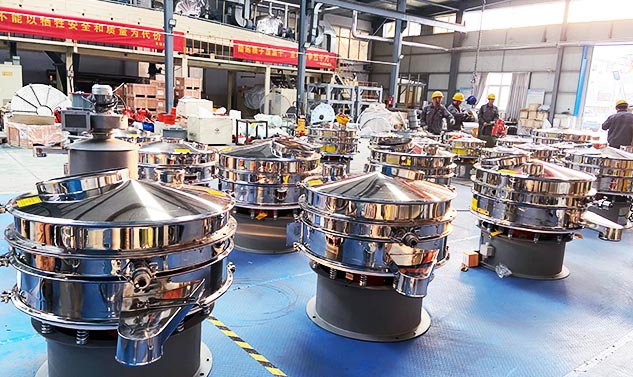
The two machines are not rivals at the same duty. One is built for volume and awkward shapes, the other for fine cuts and small footprints — and the split shows up in the feed size first.
By CHENWEI · October 22, 2026 · 5-minute read
TL;DR
- Maximum feed size separates the two ranges fastest: 100 mm on the tumbler sieve, 20 mm on the rotary vibrating screen.
- A tumbler sieve uses a long stroke at low frequency; a rotary machine uses a short stroke at high frequency, which is what makes fine cuts practical.
- Screen area overlaps between 0.44 and 2.85 m², so above that ceiling only the tumbler range goes further.
- Choose on the material's shape and the cut, not on the frame diameter. Where a data sheet says nothing, ask in writing.
A tumbler sieve and a rotary vibrating screen are often quoted for the same line, which makes them look interchangeable. They are not. The differences that matter are the maximum feed size, the character of the motion, and the range of screen area each frame can offer.
Both machines sort dry powder and granules with a driven deck. The choice turns on the material and on how fine the cut has to be.
The Two Ranges Side by Side
Where a cell says not published, the data sheet is silent: ask for the figure in writing rather than inferring it.
Between 0.44 and 2.85 m² both ranges can be quoted, and there the choice rests on material and cut, not capacity.
Feed Size Is the First Hard Line
The line is 20 mm. Material coarser than that cannot enter the rotary range at all.
A rotary vibrating screen is specified for feed below 20 mm, so anything arriving as lumps needs reduction upstream. A tumbler sieve takes up to 100 mm on every model, so one stage accepts material that would otherwise need a crusher ahead of it.
That changes plant layout: removing an upstream reduction step removes its power draw, dust control and maintenance.
Above 20 mm, the decision is effectively made. Below it, the other variables start to matter.
What the Long Stroke Does to Fragile and Awkward Shapes
A 20 to 70 mm stroke at 220 to 280 r/min carries material in a rolling bed instead of flicking it against the wire.
That is why the tumbler range is specified for spherical, cylindrical and flake shapes, and for material that breaks or deforms easily. Repeated high-frequency impact chips the edges of a flake; a rolling bed gives it fewer hard contacts over the same distance.
The motion also has a cost. A slow, long stroke spends more time moving material across the deck and less time presenting fresh aperture. A study of vibrating screen kinematics sets out the trade-off: lower particle velocity means more collisions with the screen surface and more chances to pass, but longer residence time and lower processing efficiency (Chen, Tong & Li, 2020). The tumbler is built around the first half of that trade, and its screen area is what compensates for the second. The study models an elliptical twin-shaft deck rather than a round tumbler, so read its relations as direction rather than as a setting for your unit.
Where the Rotary Machine Still Wins
For a fine cut, the rotary range is the only one of the two with published mesh data.
The S49-B range screens from 3 to 500 mesh on one to four decks, and multiple decks let one frame deliver several fractions in a single pass. The tumbler data sheet does not publish a mesh range, so any fine-cut duty needs a written confirmation before it can be compared at all.
Three situations therefore point back to the rotary machine:
- The cut is fine, and the aperture has to be guaranteed rather than inferred.
- The duty needs several fractions from one frame, such as oversize, product and fines.
- Throughput is modest enough that 0.44 m² already exceeds what the line needs.
A rotary deck also targets near-size material. A study of particle size distribution found that the fraction between 0.7 and 1.0 times the aperture is the group that inhibits screening efficiency, while oversized particles improve it by aiding stratification (Shen et al., 2025). That behaviour applies to both machines, but the rotary deck's higher contact rate is aimed squarely at it.
FAQ
Is a tumbler sieve better than a rotary vibrating screen?
Neither is better in general. A tumbler sieve handles coarser feed and fragile or irregular shapes. A rotary vibrating screen handles fine cuts and multiple fractions on one frame with published mesh data. The material decides.
Can a tumbler sieve replace a rotary vibrating screen?
It can replace one on coarse to medium cuts with awkward shapes, and it will take feed the rotary range cannot. It cannot be assumed to replace one on a fine cut until the mesh range for the specific model is confirmed in writing.
What is the main difference in motion?
The rotary machine moves the deck in three dimensions at high frequency with a short stroke, so particles bounce repeatedly against the wire. The tumbler combines a plane circular motion with an upward parabolic throw at low frequency and a long stroke, so the bed rolls across the deck.
What This Means for Your Line
Start with the feed. Above 20 mm, the tumbler sieve is the only one that can take it, and the decision is over before capacity is discussed.
If the feed is already fine and the cut must be guaranteed to a mesh figure, the rotary machine is the documented option; the rotary vibrating screen range for fine cuts sets out its mesh and deck limits.
If the product's shape is the problem rather than its size, how the circular and parabolic motion is produced explains what the long stroke does that a short one cannot.
And if the answer is a tumbler, the seven frames from 0.44 to 5.30 m² and their motor ratings are listed under tumbler sieve models and screen areas.
About Xinxiang Chenwei Machinery Co., Ltd. (CHENWEI Machinery)
Xinxiang Chenwei Machinery Co., Ltd. (CHENWEI Machinery) is a food processing and packaging machinery manufacturer based in Xinxiang, Henan, China. Its screening range covers rotary vibrating screens, ultrasonic vibrating screens and tumbler sieves for powders and granules in food, pharmaceutical and chemical production. Cutting, welding, polishing, assembly and performance testing are handled in-house, non-standard configurations are available, and machines are exported to Southeast Asia, the Middle East, Africa and South America.
Sources
- Chen Z., Tong X., Li Z. (2020). Numerical Investigation on the Sieving Performance of Elliptical Vibrating Screen. Processes, 8(9), 1151.
- Shen G., Xu Z., Dong F., Wang X., Luo B., Zhang G. (2025). Effect of particle size distribution on screening efficiency of vibrating screen. Scientific Reports, 15:39677.
- Xinxiang Chenwei Machinery Co., Ltd. Tumbler Sieve CWYS and Rotary Vibrating Screen S49-B technical data sheets.
 24 Hours Online Service For You: +86 13462227588