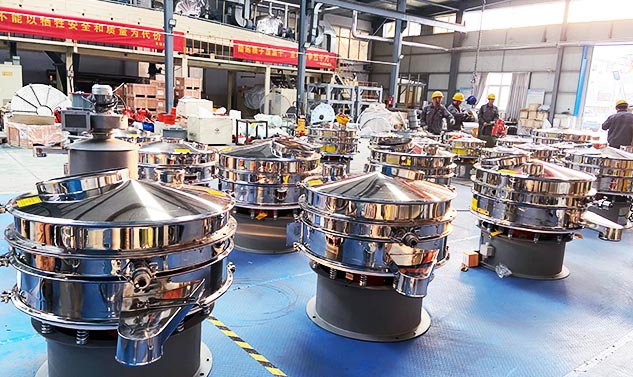
At the small end of the range the two machines share a motor size, a mesh range and a round deck. What separates them is whether the material is something you pour or something you convey.
By CHENWEI · October 29, 2026 · 5-minute read
TL;DR
- The smallest rotary screen and the 450 filter both list 0.18 kW, so power tells you nothing about which one fits.
- A filter contains the material: hopper below the deck, filtrate returned to a vessel, splash kept inside the body.
- A rotary screen distributes it: one to four decks, an outlet at the rim, and enough area to grade a dry stream.
- Deck count, discharge geometry and mounting separate the two more reliably than any other published figure.
Buyers often arrive at this comparison expecting a capacity answer. The useful answer is about form. A vibrating filter takes a batch of paste or slurry, holds it in a body, and returns filtered liquid downwards. A rotary vibrating screen takes a stream of powder or granules and moves it across one or more decks until each fraction reaches an outlet at the rim.
Once that is clear, the numbers arrange themselves: both appear in the same catalogue with overlapping mesh ranges and, at the smallest size, the same motor rating. Neither fact decides the purchase.
Same Motor, Different Job
The 450 filter and the S494-B rotary screen are both listed at 0.18 kW, and they are not substitutes. What differs is what the motor is asked to do: keep a wet screen clear under a head of liquid, or drive a deck that carries dry material to an outlet.
Where a cell says not published, the data sheet is silent. Ask in writing; the missing figure usually matters more than the printed ones.
Containment Decides Before Area Does
A slurry has to be fed into something closed, and that single requirement removes the rotary screen from most wet duties. Pouring a suspension onto an open round deck throws material outward, and the outlet at the rim delivers it sideways, which is exactly right for dry solids and awkward for a liquid that has to go back into a tank.
On the CW-450 vibration filter, the hopper sits under the screen and directs filtrate downwards into a bucket, a tote or the next vessel. The body keeps the splash in. On a food or pharmaceutical line that is not a convenience: splash is product loss, and it is a cleaning burden that a washdown schedule has to absorb.
Containment also decides the feed method. A filter takes material from a ladle, a drum pump or a gravity line, because the body receives rather than distributes. A rotary screen expects a controlled feed onto the centre of a deck, which means a hopper and feeder above a fixed installation.
Deck Count and Fractions
A rotary screen can carry one to four decks, so one pass delivers two, three or four fractions. That is why it suits a product range with several grades that must be separated without a second machine.
A filter gives one cut. Everything that passes the mesh leaves through the hopper; everything retained stays on the cloth until the batch ends and the screen is cleaned. For filtration that is the correct behaviour, because the retained material is waste or rework rather than a saleable fraction.
If a duty needs both — a filtered liquid and a retained fraction worth recovering — the practical arrangement is two machines rather than one clever one, because the retained cake on a filter is not a graded product.
Mounting, Mobility and the Real Footprint
At 40 kg and half a metre square, the filter is equipment you move; at 430 mm and up, the rotary screen is equipment you install. That difference drives maintenance as much as layout: a filter can be wheeled to a wash bay, and a rotary screen has to be cleaned where it stands.
Mobility also sets the batch size it can serve. A machine that is moved between vessels is serving batches measured in hundreds of litres, not a continuous flow. When the duty becomes continuous, the filter's single light drive and small deck become the limit, and a larger wet-screening arrangement is the honest answer rather than a bigger filter.
Where Neither Machine Fits
Two boundaries matter. Below about 150 µm in a dry powder that blinds, the answer is usually an ultrasonic screen rather than more amplitude. And for a continuous slurry at production tonnage, neither a 40 kg filter nor a standard rotary screen is sized for the duty; both are the wrong shape for the flow.
Between the two machines in the title, the rule is short. Batch, contained, one cut, mobile: filter. Continuous, distributed, several fractions, fixed: rotary screen.
FAQ
Can a vibrating filter replace a rotary screen?
Only where the duty is a contained batch with one cut. A filter cannot deliver several fractions, and its single small deck is not sized for a continuous dry stream.
Is a vibrating filter better for wet material?
For a slurry or paste it is the better fit, because the hopper and body contain the material. A rotary screen can be fed wet material, but its rim outlet delivers it sideways, which complicates recovery.
Why are both listed at 0.18 kW?
The rating describes the motor, not the duty. The smallest rotary frame and the 450 filter need similar excitation to keep a screen clear; what they do with that motion differs entirely.
What This Means for Your Specification
Write down three things before comparing quotations: whether the material pours or is conveyed, whether the retained fraction is waste or product, and whether the machine stays in one place. Those three answers pick the family, and only then does mesh selection matter.
The mesh decision is a separate exercise, set out in how to choose a filter mesh for your slurry. If the answer is a filter, what the 450 type vibration filter is built from covers the five components and the published limits of that unit.
About CHENWEI
Xinxiang Chenwei Machinery Co., Ltd. (CHENWEI Machinery) is a food processing and packaging machinery manufacturer based in Xinxiang, Henan, China. Its screening range covers rotary vibrating screens, ultrasonic vibrating screens, direct discharge screens, vibration filters and tumbler sieves for powders, granules, pastes and slurries in food, pharmaceutical and chemical production. Cutting, welding, polishing, assembly and performance testing are handled in-house, non-standard configurations are available, and machines are exported to Southeast Asia, the Middle East, Africa and South America.
 24 Hours Online Service For You: +86 13462227588